
Spreadsheets Out. Scale In.
Construction draw tracking, loan pipelines, and servicing workflows, rebuilt on Monday.com and wired into the systems you already run. Fixed scope. Ninety days. Your team owns it at handoff.
Monday.com Certified Partner·Engagements start at $15,000·Phoenix, AZ
A real automation, recorded live.
Not a product tour. An actual CtrlCap build, moving real work.
Four places it breaks first.
The same walls, at almost every lending shop, at roughly the same volume.
The draw log only one person understands
Inspections, budgets, retainage, and disbursement approvals live in tabs held together by formulas nobody wants to touch. When that person takes a week off, draws slow down. When they leave, the process leaves with them.
Pipeline status is a Friday email
Origination, conditions, and funding sit in three different places, so the only way anyone knows where a loan stands is to ask. Borrowers feel the lag before you do.
Investor reporting is a rebuild, every quarter
The numbers exist. Assembling them into something an investor can read takes days of copy, paste, and reconciliation, and every cycle is a fresh chance to be wrong in public.
Your systems do not talk to each other
The CRM, the LOS, the servicing platform, and accounting each hold a piece of the truth. People are the integration layer, rekeying data between them, and rekeying is where errors are born.
None of this is a software problem. It is an operations problem that software has been asked to hide.
Three systems, built for how lending actually runs.
Migration, automation, and dashboards are the tools. These are the outcomes they are pointed at.
Draw Management
The construction draw cycle, end to end, in one place: budget lines, inspection status, fund control approvals, and disbursement. Every draw carries an owner, an age, and an audit trail.
- Budget and line-item tracking against the approved schedule of values
- Inspection and fund-control approval gates with automatic routing
- Retainage and holdback logic the system enforces, not a hidden formula
- Aging alerts on any draw sitting past your service standard

 Before: the workbook
After: the system
Before: the workbook
After: the system
Loan Pipeline
Application through funding on one board, with conditions tracked as work rather than as a checklist someone remembers to update. Anyone can answer "where is this loan" without sending an email.
- Stage gates from submission to conditions to clear-to-fund
- Condition tracking with owner, due date, and automatic follow-up
- Investor and capital allocation visible at the loan level
- Connected to your LOS or CRM where an API exists
Servicing and Investor Reporting
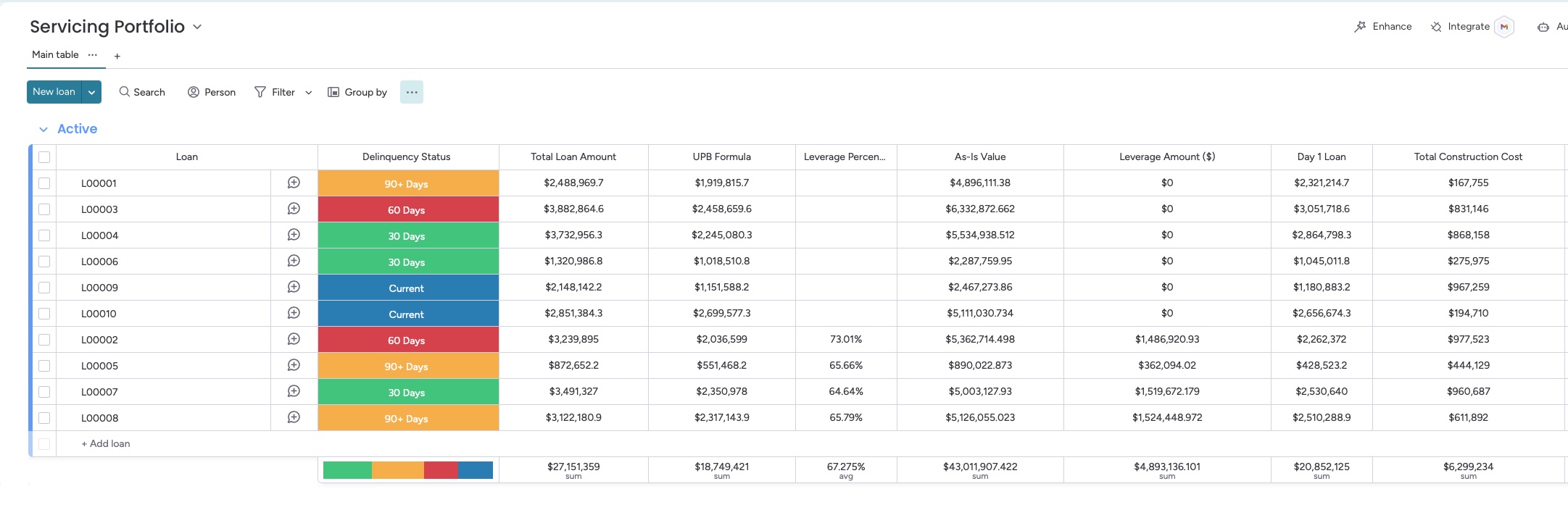
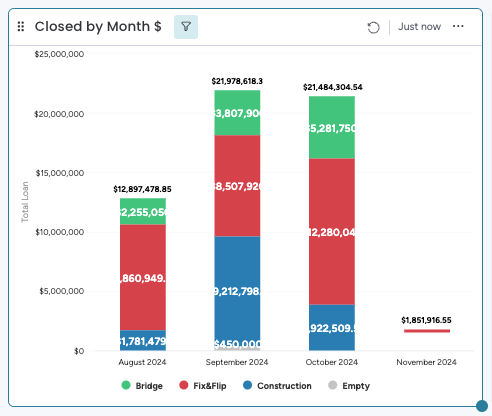
Payoffs, extensions, delinquency, and workout files in a real queue, feeding dashboards that answer the questions your investors and your credit committee ask before they ask them.
- Servicing exception queues with aging and escalation
- Portfolio dashboards by asset class, vintage, and status
- Investor-ready reporting views that assemble themselves
- Permissions so an investor sees their position and nothing else
Monday.com at the core. Everything else stays connected.
Your CRM, LOS, and servicing platform keep doing their jobs. The build connects them so your people stop being the integration layer.
Monday.com
Boards, automations, dashboards, and custom apps. Certified Partner. This is where your team works every day.
Salesforce
Loan data flowing out of Salesforce automatically, in a pipeline that runs daily in a real lending shop.
The Mortgage Office
Loan boarding by API instead of by hand. The 90-minutes-to-5 number comes from this integration.
Snowflake
The data layer between origination and servicing in the boarding pipeline. Clean data in, clean data out.
Microsoft Dynamics
CRM workflows and data structures I know from the operating side. Connectable where the API allows.
Quickbase
Low-code operations apps I have worked in. Migration path or integration, depending on what you need.
If your system exposes an API, it can feed the build. And when Monday.com cannot do something out of the box, I build the app that does. My draw-management app, a FastAPI service with a React interface, runs today and the code is public.
Ninety days, fixed scope, and a handoff that actually hands off.
The scope and the number are agreed before anything is built. If the scope changes, we both decide that on purpose.
Discovery
Two weeks sitting with the people doing the work, mapping the process as it actually runs, including the exceptions nobody documented. You keep the map whether or not you continue.
Build
Boards, automations, integrations, and dashboards, built against the map. You see working software every week, not a status deck.
Parallel run
Your team runs live work in the new system while the old process is still standing. We fix what breaks under real volume, not in a demo.
Handoff
Admin training, written documentation, and recorded walkthroughs. Your team can change the system without calling anyone. That is the point.
A number, before the work starts.
A full rebuild across draw management, pipeline, and servicing reporting typically runs $20,000 to $45,000, depending on how many workflows are in scope, which systems need integrating, and how many years of history come along.
Discovery is priced separately if you want to start smaller. You keep the process map either way.
No hourly billing. No scope creep you find out about on an invoice. Ongoing support after handoff exists as an option, never as a requirement.
Built in the operating seat, not from a playbook.
The one part of CtrlCap a competitor cannot copy: fifteen years of doing the work before selling it.
Fifteen years inside private real estate lending: loan servicing, fund control, asset management, workout, and secondary-market loan sales across RTL, fix-and-flip, and DSCR. The draw cycle CtrlCap rebuilds for clients is one I was accountable for.
Rebuilding fund control off spreadsheets in that seat took the reimbursement cycle from seven days to two, eliminated manual reconciliation errors, and doubled fund-control throughput. Those are operating results, not a client engagement, and the site says so plainly because that is the honest version.
What lenders ask first.
No. Your system of record stays your system of record. What gets rebuilt is the operational layer that currently lives in spreadsheets and inboxes: draw tracking, pipeline status, condition follow-up, and reporting. Where an API exists, the two get connected so nobody rekeys data between them.
Monday.com is the core of every build, and it is where your team will work day to day. But the build connects to what you already run. A production pipeline moving loan data from Salesforce through Snowflake into The Mortgage Office is shipped work. Microsoft Dynamics and Quickbase are systems I have worked in. If your system exposes an API, it can feed the build, and what is realistic gets scoped honestly in discovery rather than promised up front.
Your data lives in your Monday.com account, under your ownership, on your plan. Work happens inside your instance under a guest account with the access the build requires and nothing beyond it, and that access ends at handoff. Board-level and column-level permissions get configured as part of the build so investors, borrowers, and staff each see only what they should.
I do. CtrlCap is a solo practice by design. There is no account manager between you and the person building your system, and no junior consultant learning private lending on your budget. The tradeoff is a limited number of builds at a time.
And before you ask about the single-person risk: everything is built inside your Monday.com account, under your ownership, documented as it goes. From week one you hold the process map, and from week three you hold working software. Nothing about your operation is ever hostage to any one person, including me. A retainer agency cannot say that, because their model depends on you needing them next quarter.
Engagements start at $15,000. A full rebuild across draw management, pipeline, and servicing reporting typically runs $20,000 to $45,000 depending on scope, integrations, and data volume. The number is fixed before work begins.
You own it. Handoff includes admin training, written documentation, and recorded walkthroughs so your team can change the system themselves. Thirty days of support after handoff is included.
After that, you have two options. Most teams run the system on their own, and the build is designed so they can. If you would rather not carry the maintenance, an ongoing support plan is available: admin changes, new automations, and tune-ups as your process evolves. The difference between that and an agency retainer is that you choose it, and you can leave it, because the system never depends on it.
It will, and the build assumes it. Boards, statuses, and automations are structured so an admin on your team can add a loan product, change an approval path, or add a reporting view without touching anything fragile. That is what week 12 training is for.
Tell me what your draw cycle looks like.
A short call, no deck. If CtrlCap is not the right fit, you will hear that on the call.
Or reach me directly.

Spencer Medrano, founder. Fifteen years in private lending operations. Read the background →